
Pool Filter Repair and Replacement Near Leander
Pool filter repair in Leander covers cartridge, sand, and DE systems. We replace worn media, torn grids, failed O-rings, and split manifolds, restore the filter to proper working pressure, and tell you honestly when the whole unit is past repairing.
Request A Free Quote
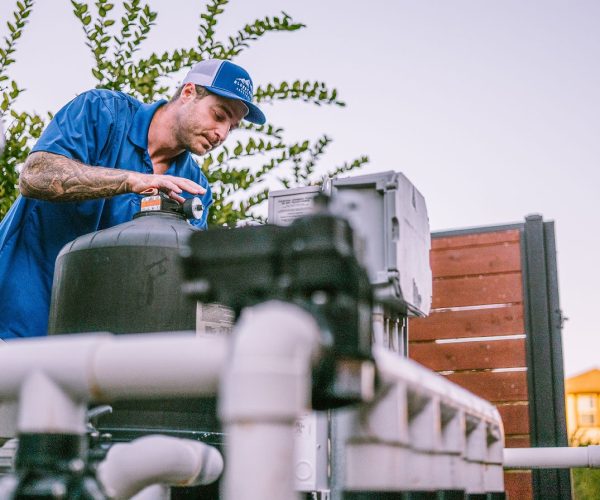
When cleaning is not enough
A filter that’s been properly cleaned and still can’t hold pressure or clear the water has a mechanical problem, not a dirt problem. At that point, another cleaning is money spent for nothing. Request a free quote, and we’ll find out what’s actually wrong.
We repair and replace cartridge, sand, and DE filters across Leander and the northwest Austin corridor. Fully insured, and we’ll tell you honestly whether yours needs a part or a replacement.
How filters actually fail
Each type fails in its own way, and the symptoms overlap enough to be confusing. Cloudy water, high pressure, and a pool that never quite looks right can all come from very different underlying faults, which is why guessing at parts is an expensive way to solve this.
Cartridge filters wear out. The pleated media breaks down after years of loading and cleaning, and once the pleats collapse or tear, water finds the path of least resistance and goes around the filtration rather than through it. A cartridge that looks fine can still be finished.
Sand filter channel. Over years, the sand bed compacts and water carves paths straight through, so most of the water isn’t touching most of the sand. Backwashing doesn’t fix a channeled bed. The sand itself also wears smooth and loses its ability to catch fine particles.
DE filters tear. The grids are fabric over a frame, and once a grid tears, DE powder blows straight back into the pool. If you’re seeing DE in the water after recharging, that’s the tell.
Housings crack. Central Texas sun makes plastic brittle over time, and a cracked housing or a failed clamp band leaks under pressure. A filter that weeps a little when the pump kicks on is telling you something, and it rarely gets better on its own.
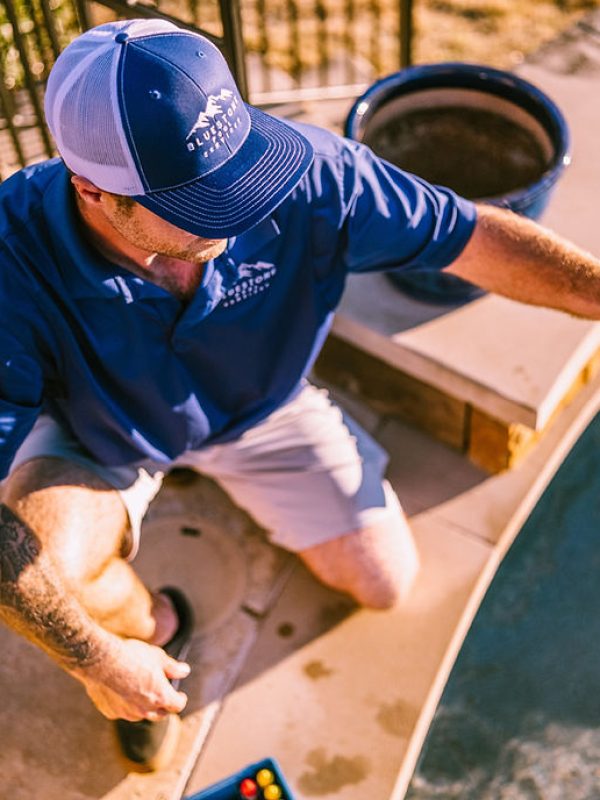
What we repair
Cartridge replacement. New elements sized correctly for your system, because an undersized cartridge is a filter that clogs constantly.
DE grid replacement. Individual grids or full sets, plus the manifold if it has gone.
Sand replacement. Old sand out, correct grade and volume in. This is dirty work, and it’s worth doing properly.
O-rings, clamps, and gaskets. The parts that leak, and often the entire fix.
Pressure gauges. A broken gauge means you’re flying blind on the one number that tells you what your filter is doing.
Housing and valve repair. Multiport valves fail internally and bypass water, which is a maddening problem to diagnose from symptoms alone.

Repair or replace the whole filter
Most filter problems are repairs. Grids, cartridges, sand, and O-rings are all serviceable parts, and replacing them costs a fraction of a new filter.
Full replacement makes sense in two cases. The first is a cracked or failing housing, since the tank is the filter, and a compromised tank under pressure is not something to nurse along. The second is an undersized filter, which is more common than people realize. A filter that’s too small for the pool will never keep up no matter how new it is, and it clogs constantly. If your filter has always struggled, that may be why, and replacing parts won’t change it.
Once the filter is right, regular filter cleaning keeps it that way. Our full pool repair service covers the rest of the equipment.
Is your filter the right size
This is worth its own section, because it’s the problem people live with for years without realizing it’s a problem.
Filters are rated for a certain flow, and a certain pool volume, and plenty of pools were built with a filter sized to the budget rather than to the pool. An undersized filter clogs fast, runs high pressure almost immediately after cleaning, and never quite gets the water clear no matter what you do to it.
The tell is a filter that seems to need cleaning constantly. If you’re deep cleaning every few weeks and the pressure is back up almost immediately, the filter probably isn’t failing. It’s just too small for the job, and it has been the whole time.
Oversizing, on the other hand, is nearly free. A larger filter runs longer between cleanings, catches finer particles, and puts less strain on the pump. When someone is replacing a filter anyway, going up a size is usually the best money on the whole project, and we’ll say so.
Where we repair filters
Across the corridor, from Leander across to Round Rock.
We handle filter repairs in Pflugerville and Georgetown as well, plus Cedar Park, Liberty Hill, and the Lake Travis communities.
See our areas served page for the full list.
Pool filter repair FAQs
How do I know if my filter needs repair or just cleaning?
The test is what happens after a proper deep clean. If a filter we’ve fully cleaned still runs high pressure or still won’t clear the water, then something is mechanically wrong rather than dirty. Cleaning removes debris and calcium, but it can’t fix collapsed cartridge pleats, sand that has channeled, torn DE grids, a split manifold, or a cracked housing. Those need parts, and no amount of additional cleaning will bring them back.
How long does a pool filter last?
It depends entirely on the media, because each type wears out in its own way. Cartridge pleats gradually break down and stop sealing after a few years of cleaning cycles. Sand grains wear smooth over several years until water channels straight through instead of being strained. DE grids last well until the fabric tears. Our hard water and long running season push every one of those toward the shorter end of its normal range.
I see DE powder in my pool. What is wrong?
That’s a torn grid or a failed manifold, and it’s telling you something inside has split open. DE powder is supposed to stay in the filter, coating the grids, so powder returning to the pool means it’s taking a shortcut past the fabric. It’s worth fixing promptly for two reasons: you’re losing real filtration every hour it runs, and you’re paying to recharge powder that ends up back in the pool.
My filter pressure is low, not high. Is that bad?
Low pressure is often the more worrying of the two. High pressure at least tells you the filter is doing its job and has loaded up with what it caught. Low pressure usually means water isn’t properly reaching the filter at all, which points upstream at the pump, a clog on the suction side, or a valve bypassing internally and routing water around it. A filter nothing flows through isn’t filtering, however clean the gauge makes it look.
Can I replace the sand in my sand filter myself?
You can, and plenty of people do. Fair warning though: it’s heavy, messy work, a few hundred pounds of wet sand that has to come out by hand. Getting the right grade and the right volume back in matters, and the real risk is cracking one of the laterals at the bottom of the tank while you’re digging the old sand out, because that turns a sand change into a much bigger repair.
Is it worth repairing an old filter or should I replace it?
Usually repair, because almost everything inside a filter is a serviceable part: cartridges, grids, sand, laterals, and O-rings can all be renewed. There are two exceptions worth knowing. If the housing itself has cracked, the tank is the filter, and it’s done. And if the filter was undersized for your pool to begin with, it will never keep up no matter how new the internals are, so replacing it with the right size is the honest fix.
How much does pool filter repair cost?
Repairs are priced by which component actually failed, not by the filter type, so the range is wide. A set of o-rings or a single lateral is a small job. A complete DE grid set or a full sand change, where the media itself plus the labor of hauling it is the bulk of the work, sits considerably higher. We diagnose it first and tell you exactly what the repair involves before any work begins.
If a clean filter still cannot hold pressure, something is broken. Tell us what it is doing.