
Pool Heater Repair for the Leander Area
Pool heater repair in Leander covers gas and electric units that will not fire, cycle off early, or throw errors. We diagnose the real cause, which is often flow or scale rather than the heater itself.
Request A Free Quote
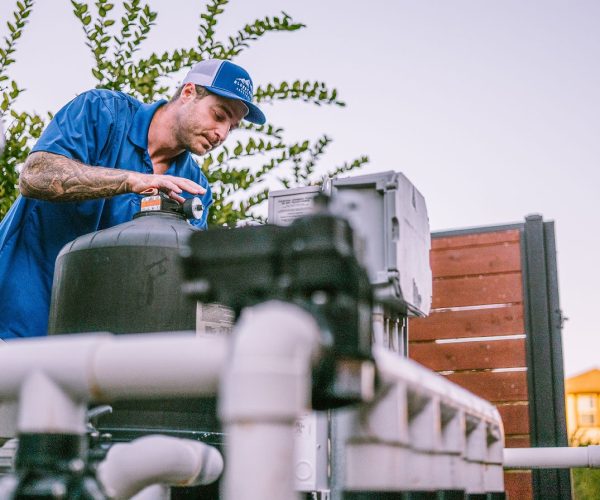
When the heater will not fire
A pool heater is the one piece of equipment people only think about on the day it matters, which is usually the first cool evening they want to swim. If yours isn’t firing, cycling off early, or throwing an error code, request a free quote, and we’ll diagnose it.
We repair gas and electric pool heaters across Leander and the northwest Austin corridor. Fully insured, and we’ll be straight with you about whether a repair makes sense on your unit. Our guide on why a heater won’t fire covers the safe checks before a service call.
Why heaters stop working
Heaters are the fussiest equipment on a pool, because they have safety systems designed to shut them down at the first sign of trouble. That’s a good thing, but it means a heater that won’t fire is often protecting itself rather than broken.
Not enough flow. This is the most common cause, and it isn’t a heater problem at all. Heaters have a flow switch that prevents firing without adequate water movement. A clogged filter, a failing pump, or a closed valve will stop the heater cold. Fix the flow and the heater works.
Scale on the heat exchanger. This is the Central Texas problem. Our hard water deposits calcium inside the exchanger, which insulates it, makes it work harder, and eventually causes overheating and shutdowns. Unbalanced water accelerates it enormously.
Ignition problems. On gas heaters, a dirty or failed igniter, a bad flame sensor, or a gas supply issue stops it before it starts.
Failed sensors. Pressure switches, thermostats, and high-limit switches all fail, and any of them will keep a perfectly good heater from running.
Rodents and wasps. Genuinely. Heaters sit outside; they’re warm, and things nest in them. It’s a more common cause of failure than most people expect.
How we approach a heater call
We check the boring things first, because the boring things are usually it. Is water actually flowing? Is the filter clean? Is the gas on? Is a valve closed?
Then we work through the safety chain, because a heater that won’t fire is usually being stopped by something, and finding out what is faster than guessing at parts. Error codes help, though they point at symptoms more than causes.
What we won’t do is replace parts until something works. That gets expensive fast, and it’s a sign nobody actually diagnosed the problem. Heaters have enough components that swapping them one at a time can run up a serious bill without ever finding the fault.
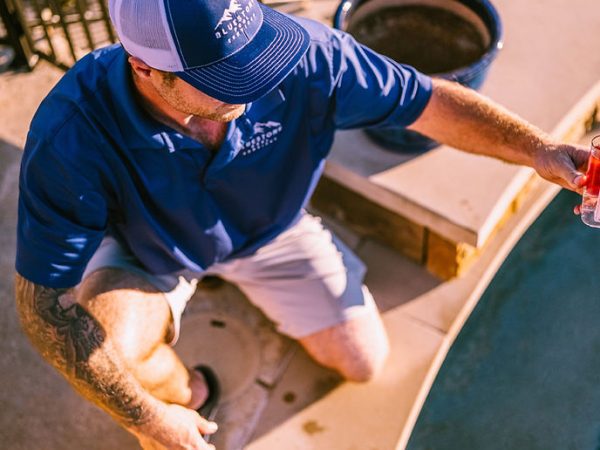

Repair or replace
Heaters are the one piece of equipment where replacement gets serious quickly, so this deserves an honest answer.
Sensors, igniters, flow switches, and thermostats are repairs, on almost any heater worth keeping. A scaled heat exchanger can often be cleaned rather than replaced, depending on how far it has gone.
A failed heat exchanger on an older heater is where the math changes, because the exchanger is the expensive part, and on an aging unit you can spend most of the cost of a new heater fixing an old one. We’ll lay out both numbers and let you decide rather than steering you.
The best thing you can do for a heater in this area is keep the water balanced, since scale is what kills heat exchangers here. That’s part of any maintenance plan. Our full pool repair service covers the rest of the equipment.
Do you actually need a heater in Central Texas
Worth asking honestly, because heaters are expensive to buy, expensive to run, and expensive to fix.
Our swim season is long without any help. Pools here are comfortable for a big chunk of the year on sun alone, and a heater does nothing for you through the months when the pool is already warm. That’s a lot of the year.
Where a heater earns its keep is the shoulders, the weeks in spring and fall when the air is lovely, and the water is just cold enough to keep everyone out. A heater turns those weeks into swimming weeks, and for families who want the pool usable in March and November, that’s genuinely worth it.
What a heater will not do economically is keep a pool warm through a Texas winter. The running cost of that is steep, and people who try it once usually don’t try it twice.
So if your heater has failed and you’re weighing an expensive repair, that’s the real question: do you swim in the shoulder seasons? If you do, fix it. If the heater has sat unused for three years, that tells you something, and there’s no shame in letting it go.
Where we repair heaters
Across the corridor, from Leander down to Lakeway.
We see a lot of heaters on custom pools in Bee Cave and West Lake Hills, and we cover Cedar Park, Georgetown, Round Rock, and the Lake Travis communities too.
See our areas served page for the full list.

Pool heater repair FAQs
Why will my pool heater not turn on?
Most often the heater isn’t getting enough water flow, so its pressure switch is doing exactly what it’s designed to do and refusing to let it fire. A clogged filter, a struggling pump, or a partly closed valve will all trigger that. It’s genuinely good news when this is the cause, because the heater itself isn’t broken at all, and restoring proper flow usually brings it straight back to life.
What does it mean if my heater fires then shuts off?
That pattern is called short cycling, and it points to either flow or overheating. Either water isn’t moving through the heater fast enough to carry the heat away, or a scaled-up heat exchanger is trapping heat until the unit trips its own high-limit safety. Both are worth diagnosing properly rather than repeatedly resetting it, because every one of those overheating cycles takes life off the heat exchanger.
Does hard water damage pool heaters?
Yes, and it’s far and away the main way heaters die in Central Texas. Calcium from our limestone water plates out inside the heat exchanger, where it acts as insulation between the flame and the water. The heater then has to run hotter and longer to reach the same temperature, which accelerates the scaling and eventually cracks or burns through the exchanger. Balanced water is genuinely the best heater maintenance there is.
Do you repair both gas and electric pool heaters?
Yes, both. Gas heaters bring ignition, gas valve, and burner problems on top of the flow and sensor faults that affect every heater. Electric heat pumps have their own distinct failure modes around refrigerant, the reversing valve, and the fan. What they share is that flow problems and scale take out either type, which is why we start diagnosis at the pad and the filter rather than assuming the heater is at fault.
Is it worth repairing an old pool heater?
It hinges almost entirely on whether the heat exchanger is the failed part. Sensors, pressure switches, igniters, gas valves, and control boards are all worth repairing; they’re a modest fraction of the heater’s value. The heat exchanger is different: it’s the single most expensive component in the unit, so replacing one in an aging heater costs enough to approach a new heater. That’s exactly where you deserve both numbers side by side.
How long should a pool heater last?
More than any other piece of pool equipment, a heater’s lifespan is decided by water chemistry rather than by age or hours. The same model running in properly balanced water will outlast one running in scaling water by years, because scale inside the heat exchanger is what actually kills heaters here. Two identical units installed the same week can be a decade apart in life purely from how the water was kept.
Can a dirty filter really stop my heater from working?
Absolutely, and it’s one of the most common heater calls we get. The heater needs adequate water flow before its pressure switch will allow it to fire, and a loaded filter restricts that flow just as effectively as a closed valve would. It’s why we check the filter and the pump before we ever start pulling a heater apart, and why a straightforward filter cleaning often brings the heat right back.
Get a free quote for pool heater repair.
Heater not firing? It is often something simpler than you think. Tell us what it is doing.